

Self-adhesive plastic labels: not all films are created equal
When businesses need labels more durable than paper decals, plastic self-adhesive labels are the inevitable upgrade. But stepping into the world of film labels, the first question isn’t about price—it’s about choosing BOPP, PET, or PP. Choosing the wrong film can cause an entire batch of labels to be rejected; material waste and production line downtime are the two biggest hidden costs, ones that businesses often only realize when it’s already too late.
The three most common film types in industrial label films differ significantly in mechanical properties, environmental resistance, and cost. Understanding these differences correctly helps businesses make the right choice from the very first time, avoiding waste of both money and production time.
BOPP: The Balanced Choice for Most Applications
BOPP (Biaxially Oriented Polypropylene) is the most popular film in the self-adhesive plastic label line thanks to its cost-effectiveness and stable performance. BOPP offers excellent clarity, a smooth surface for sharp print quality, and natural water-resistant label capabilities. White BOPP delivers high contrast, making it ideal for dry foods, beverages, and general personal care and cosmetic products. Clear BOPP creates a no-label look effect for transparent bottles and containers. Main limitation: BOPP has poor resistance to high heat and shrinks at temperatures above 80°C, making it unsuitable for products requiring heat sterilization.
PET: The Premium Standard for Harsh Environments
PET (Polyethylene Terephthalate) is the highest-grade film in the lineup, offering exceptional clarity, heat resistance up to 150°C, and significantly superior chemical and solvent resistance compared to BOPP. PET is the default choice for pharmaceutical labels requiring sterilization, electronics labels that withstand heat during reflow soldering, industrial chemical labels, and premium cosmetic labels that demand an absolutely luxurious appearance. The rigidity of PET also ensures more stable label performance on high-speed labeling machines, minimizing downtime caused by label jams. While PET costs 20-40% more than BOPP, in demanding environments this expense is far lower than the risk of product recalls due to label failure.
PP: Solution for Flexible Bottles and Curved Surfaces
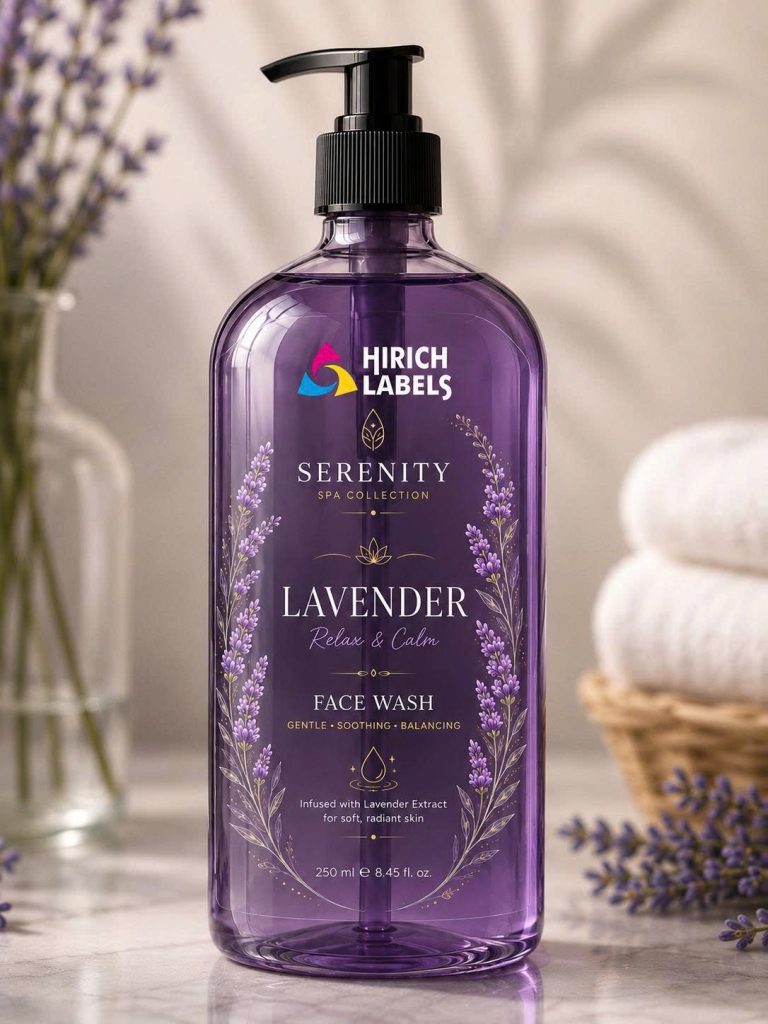
PP film offers excellent flexibility and stretchability, making it ideal for squeezable bottles such as shampoo, body wash, and condiment squeeze bottles. PP adheres well to curved surfaces and resists peeling even when the bottle is squeezed or deformed during use—a common issue when rigid BOPP is used on flexible bottles. However, PP is more challenging to print on due to its low surface energy, requiring corona treatment or primers, and its production cost is typically higher than that of BOPP.
How to choose the right film to minimize waste?
Principle: choose film based on the end-use environment, not unit cost. Premium cosmetics and pharmaceuticals → PET. Dry food, beverages, and general retail → BOPP. Squeezable bottles and light chemicals → PP. Electronics and heavy industry → PET. Hirich performs film-adhesive-surface compatibility testing on actual samples before mass production, enabling businesses to catch issues at the sample approval stage rather than on the packaging line—where every hour of downtime can cost tens of millions of VND.
© Copyright by Hirich Labels.


